Showing posts with label fantasy. Show all posts

The Symbolism and Styles of Dragon Tattoos

Dragons are mythological creatures that appear in legends, fairy tales and modern fantasy stories. They are often depicted as having a lizard's torso, head and limbs, with bat wings to allow them to fly. Some types of dragon have been described as being snake-like, wingless or having multiple heads. Dragons are a popular tattoo design because this versatile creature can be worn anywhere on the body and can be inked into the skin in a variety of sizes and styles.


The Symbolism of Dragon Tattoos


The symbolism of dragon tattoos differs according to which culture the dragon belongs to. For example, ancient Mesopotamia was filled with tales of ferocious dragons that were overcome by a courageous warrior, so the Mesopotamian dragon is a symbol of evil, menace and danger. In the Chinese animal hierarchy, the Chinese dragon is the highest ranking animal; a symbol of power and majesty.
Most dragons depicted in modern fantasy novels are large reptilian creatures with armor-plated hides and fearful talons. The overall effect is a creature that is a personification of war, freedom and power. In fantasy novels, dragons are often described as being intelligent and proud.
Dragon tattoo designs are often created to have a personal meaning for the owner of the tattoo. By combining the dragon with other symbols, a highly personal meaning can be given to the tattoo.

An Ouroboros is a circular symbol that shows a serpent (snake or dragon) biting its own tail. Although it seem like a self-defeating act for a dragon to eat itself, it is actually a symbol of eternity and wholeness. The Ouroboros (also spelled Uroborus) appears in Norse mythology as Jomungandr, a sea serpent that grew so large that it encircled the Earth and swallowed its own tail. It became known as the World Serpent. [source]

This black and white dragon tattoo fits perfectly onto this guy's back, with each wing spread out towards his shoulder blades. The design includes symbols of violence an evil: the tattooed wings have sharp points and the dragon is growling with knife-like teeth. This dragon tattoo has elements of Gothic fantasy and is likely a display of the tattoo owner's interest in these genres. [source]

A cute cartoon tattoo of a baby dragon. The tattoo designer has combined a number of symbols in this unusual tattoo design. Because the dragon is a baby, it is a symbol of future potential. The cuteness of the tattoo design symbolizes innocence and fun, and yet because the tattoo design shows a dragon, it is a symbol of power and potential violence. [source]

Chinese dragon tattoos symbolize power, majesty and grace and are often inked as a large back tattoo. Chinese dragon tattoo designs usually have whiskers and facial hair.The design generally includes a variety of organic shapes and curves, making it an ideal tattoo subject as the design compliments the natural curves of the body. [source]

How to Choose a Dragon Tattoo Design

Because tattoos are forever, you should choose your tattoo design carefully. It is also wise to go to a tattoo artist who has years of experience and is known for producing high quality work. Although you can choose a dragon tattoo design from a book or by searching online, it is often best to ask the tattoo artist to design a dragon tattoo specifically for you. That way, your tattoo will be unique to you and the design can incorporate symbols, names or phrases that have a personal meaning to you.
If you are wanting a colorful, detailed dragon tattoo, it is best to have it inked quite large, so that the dragon is visible and easy to discern. If you would prefer a small dragon tattoo, consider a design that uses a celtic or tribal style. These tattoo styles are clear and crisp so a small dragon tattoo won't seem like a blob of ink on the skin. 

This tattoo design combines a Celtic knot and a dragon, creating an attractive tattoo that uses elements from ancient European mythology and modern fantasy. Tattoos like this one can be used as a way to celebrate a person's family heritage and ancestors. [source]

A tattoo of the Welsh dragon that appears on the flag of Wales. In this tattoo design, the dragon has climbed down from the flags in the background and instead stands in front of the flags and the feathered crown that stand in the background. A tattoo like this symbolizes patriotism, loyalty and strength. The red Welsh dragon is believed to have been the heraldic symbol of King Arthur and other Celtic kings, appearing on their flags in a similar form as the dragon above. [source]

A tribal dragon tattoo that shows three dragon heads joined at the neck in an intricate knot. The clean lines of tribal tattoo designs mean that they can easily be seen from far away, and can be tattooed at much smaller sizes than highly detailed color tattoos. [source]

This cute tattoo design shows a pretty dragon with colorful butterfly wings. Although the colors of the body contrast nicely with the colors on the wings, the pose of the dragons body doesn't create a clear silhouette. Butterflies usually represent femininity, whilst dragons symbolize masculinity. This dragon butterfly tattoo design is an interesting combination of male and female aspects. [source]

This upper back tattoo uses only the dragon's wings as the tattoo design. The result makes it seems as though the tattoo owner is sprouting dragon wings. [source]

Read More on Art-Sci:


Ernst Haeckel Draws a Psychedelic World

Ernst Haeckel was a 19th century artist, philosopher and professor who had a deep interest in the natural world. His beautifully detailed illustrations of sea creatures, insects, plants and animals have survived over a century of change and are still hailed as among the best nature illustrations that exist to this day.

Photography vs Psychedelic Illustrations

The art of photography has existed for centuries, though not as we know it today. As early as the 4th and 5th centuries BC, Chinese and Greek philosophers and mathematicians described pinhole cameras. By the late 19th century, more sophisticated cameras were in use. These cameras often produced blurry images that were either over- or under-exposed, so up until the early 20th century, illustrations were the best way for scientists to share images of their findings with other biologists. These illustrations were used to identify and differentiate species of animals. Ernst Haeckel earned a name for himself for his highly detailed, intricately constructed illustrations of the natural world.


Ernst Haeckel often colored his illustrations, a technique that allowed other naturalists to imagine not just the shape and texture of the creature, but its color patterns too. During the 19th century, photographs were produced in black and white which meant that color illustrations were often valued more than photographs. [source]

This illustration, called "Orchidae", depicts several orchid flower species. Haeckel often drew collections of animals or plants of the same species, showcasing both the similarities and differences between the different breeds. [source]

Ernst Haeckel's illustrations were highly prized for their level of detail. Many nature artists of the time would simply have drawn a rough sketch of this sea creature, unlike Haeckel; who has drawn every tiny detail of the sea anemone. [source]

Natural Psychedelic Design
It's unlikely that Haeckel's intention was to create psychedelic art works. As a biologist and naturalist, Haeckel simply wanted to record the world as he saw it, as a collection of intricate patterns and subtle shades. But repetitive patterns create the basis of psychedelic art, so Haeckel's illustrations have unintentionally become mind-boggling art works.


Many of Haeckel's drawings are of sea creatures such as sea anemones. With their repetitive patterns and intricate details, these creatures are the perfect subjects for psychedelic, alienish art works. [source]

Ernst Haeckel's illustrations often have an otherworldly feel. The creature in the picture above could easily feel at home on an alien planet, yet oddly enough, it calls Earth its home. [source]

Another of Ernst Haeckel's illustrations shows several different breeds of the same jellyfish specie. In all of his art works, Haeckel included as much detail as he possibly could, making his drawings the first truly accurate visual recordings of many creatures. [source]

Ernst Haeckel died on August 9, 1919, leaving behind hundreds of nature illustrations. Nearly a century after his death, his drawings are still celebrated as being some of the most detailed and attractive biological illustrations in the world.


Read More on Art-Sci:


10 Where's Waldo Puzzles

Animal Owners Tattoo Their Pets
Funny Photoshop Head Swaps
Incredible Tattoo Designs
Photoshop Machine Animals: a Love Story of Nature & Technology
Sam Spratt has PAINTED ALL THE MEMES!

Antique Absinthe Poster Designs

Absinthe is an alcoholic beverage made from herbs such as anise, fennel and wormwood. The drink is high in alcohol and can cause mild hallucinations, making it a popular recreational drug of the late 19th century.

The Tipsy History of Absinthe
Wormwood was used by the ancient Greeks and Egyptians for use in medicinal tinctures. Over time, other herbs were added to the drink and the distillation process refined until in the 18th century, absinthe was produced. For the next century, absinthe was recommended by doctors as a healing elixir. In the 1840s, French troops were even given absinthe as a malaria preventative. The soldiers returned home with a taste for the aniseed-flavored wine, and the popularity of absinthe spread rapidly throughout France and Europe.


Above: An antique illustration of the green fairy, the personified symbol of absinthe. [source]

Above: A different take on the green fairy symbol that was introduced in the top illustration. In this postcard painting, four cherubs with green wings are showing the euphoric effects of the drink. 

Above: A poster advert for pink absinthe, a drink that was popular with women. [source]


Preparing Absinthe
There are two main preparation methods for absinthe, the French Method and the Bohemian Method. In the French Method, absinthe is poured into a glass, and covered with a strainer. A cube of sugar is placed on top of the strainer, and water poured over the sugar into the glass. The absinthe turns cloudy with the addition of water, resulting in a milky-looking drink.
The Bohemian Method is similar in set up to the French Method, except that fire is used in place of water. Absinthe is poured into a glass, covered with a strainer and a sugar cube placed on top of the strainer. The sugar cube had been pre-soaked in alcohol, often more absinthe. The cube is then set alight and dropped into the absinthe, lighting the alcohol. A shot glass of water is added to douse the flames. Sometimes the flames are allowed to self-extinguish, burning away all of the alcohol, but it is more popular to douse the flames before the alcohol is burned off.

Above: A bourgeois man pours water over a cube of sugar on a decorative strainer. The sugared water mixes with the absinthe in the glass, diluting it and sweetening it. [source]

The Demise of Absinthe
In the early 1900s, absinthe was banned in many countries. It was said that "Absinthe makes you crazy and criminal, [and] provokes epilepsy and tuberculosis". The drink, which had previously been enjoyed by people of all classes, suddenly became unpopular, and it was believed that absinthe drinkers were uncouth louts and layabouts. 
In Switzerland, absinthe bans simply forced the absinthe producers to sell their wares on the black market. Underground Swiss distillers created a form of clear absinthe which was easier to hide from the authorities.

Above: An anti-prohibition poster, condemning the authorities for banning the popular drink. The illustration parodies the burning of witches during the Christian Inquisition. [source]

Above: A propaganda poster depicts a skeleton bartender pouring absinthe for a customer. The poster portrays the absinthe drinker as sickly and hopeless. He is such a loser, in fact, that a mongrel dog has deemed his satchel worthy of becoming a urinal. [source]

Above: A late 19th century depiction of a woman drinking absinthe. This poster was illustrated during the heyday of absinthe consumption and will remain an eternal reminder of the Victorian-era popularity of this drink. [source]


Stunning Surreal Photoshop Art

Surrealism means "above reality", and is an art form which depicts highly imaginative and unlikely scenes in a realistic manner. The art form began in the 1920s, decades before artists began to create digital art on computers. The rise in popularity of Photoshop paintings has inspired a renaissance of surrealism.

The Surreal World of Photoshop
Famous surrealist painter Salvador Dali (1904-1989) worked mostly in oil paint, creating crazy landscapes that shocked and delighted the art critics of his time. Now, a century after Dali's birth, digital artists can create surreal landscapes with ease, using computer arts programs such as Photoshop.

Above: Surrealist artists often create images in which objects are melting. The painting above shows a nightclub in which everything around a beautiful girl is melting. Perhaps the artist is trying to portray that the girl is so hot, the world around her melts. [source]

Above: The Photoshop artist has used organic shapes in place of the woman's body, using only facial features, hands and a human heart to convince the viewer that the subject in the painting is in fact human. [source]

Above: Desert landscapes, cloudy skies and clocks are popular themes in surrealism. It is likely that this Photoshop artwork uses elements from real photos. [source]

Above: Photoshop allows artists to create surrealist art by combining several photographs. This world in a light bulb is an optical illusion created by altering the perspective and size of the photographic elements. [source]


Anything is Possible
The only limits that surrealist Photoshop artists face are the bounds of their own imagination. Photoshop paintings can be edited at any time, which means that several versions of the same art work can exist. A Photoshop painting can evolve over time without the original art being compromised.

Above: This surrealist Photoshop art work takes the social network Facebook literally, creating a book out of this man's face. [source]

Above: Sometimes the line between surrealism and fantasy is blurred, as both art forms describe a world in which the impossible is a reality. The Photoshop painting above shows a world in which a girl is intertwined with tree roots and branches. The painting implies that the tree is animated, and a relationship exists between the girl and the tree. [source]

Above: A whimsical surrealist painting. The Photoshop artist has taken creatures that live in water, such as clown fish and a whale, and depicted them existing happily in air. [source]


Amazing Origami Fan Art of Comic, Film and Gaming Characters

Origami, the traditional Japanese art of paper folding, has been used to create fan art figurines of popular characters.


Eric Joisel, born in 1956, is a French Origami artist. His creative designs have an organic, sculptured feel to them. Each paper sculpture is folded from a single piece of paper; following the rules of Origami purism which states that the paper must not be cut or torn in any way to assist the artistic process.

Brian Chan is an avid origami artist who creates a variety of origami fan art pieces, insects, animals and flowers. This life-size mask inspired by the movie “V for Vendetta” can be used as an original Halloween mask, or an indoor decoration.

Inspired by the movie “Batman Begins”, Chan designed an origami model of the Bat Symbol. Origami can be used to create 3-dimensional models, but some subjects like the Batman logo require a flat, 2-Dimensional effect.

Wall-E, a robot from the Disney/Pixar animated movie takes on a new form through this origami model. This design uses characteristic poses of the Wall-E figure to emphasize the lovable personality of the popular character. Even though the movie was aimed at children, adult audiences are enjoying a variety of fan art stemming from the film.

Marvel Comics character Iron Man has a fairly simple color structure of red and yellow, which makes the origami artist’s job a lot easier. Complex colors in a design can be difficult to achieve in origami, because a sheet of origami paper generally has only one color for each side

The famous and often plagiarized character Rei Ayanamie has a complex color design. An origami artist could use multiple sheets of paper to give the model more color, but in this instance, Chan has opted to use a single piece of paper for a graceful, fluid look. To add more color, he has painted the finished model.

This design by Satoshi Kamiya is of Chocobo from the popular game, Final Fantasy. The characters in Final Fantasy are complex and highly detailed, but this master origami artist has created a convincing likeness of the character from a single piece of paper.

This is another stunning design by Satoshi Kamiya of Bahamut, Dragon Lord, from the game Final Fantasy. Satoshi used clever folding to recreate the muscle structure of Bahamut, creating a powerful replica of the masculine dragon character.

Four-legged origami creatures are easier to balance than bipeds, but heavy tails and heads need to be weighted correctly so that the character can stand alone without support. Yet another gaming character from Kamiya, this model is a believable replica of Fenrir from Final Fantasy.

Origami is a term used for the art of creating a 3D object from a single square piece of paper. The term “Origami” comes from the Japanese words, “Oru” – folding and “Kami” – paper, so the word “Origami” literally means paper folding.


Traditional Origami Crane Design


The art style has its origins in ancient Japan, traditionally using flowers, birds, frogs and dragons as subject matter. The most famous traditional Japanese design is the origami crane.
Modern origami artists challenge themselves with newer subject matter, such as automobiles, sci-fi aircraft and fantasy architecture. Fan art origami is a recent addition to the world of origami, featuring stunning paper models of characters from films, computer games and comic books.

Lord of the Rings Origami by Eric Joisel

The characters from JRR Tolkien’s “Lord of the Rings” have inspired many fan art pieces. These origami models of the characters are technically difficult and highly detailed, so the project takes more time and effort than many forms of fan art.


Gandalf the Grey

Joisel’s characters are not only highly detailed; they also reflect the character’s personality through pose. This effect is extremely difficult to achieve, but the result is an amazingly accurate and realistic character model.
Creating such intense detail requires a lot of planning ahead and concentration. Mistakes in origami are often irreversible, and the artist will have to start over with a fresh piece of paper.

See more stunning origami designs from Eric Joisel here.


Fan Art by Brian Chan


Movies play a large role in fan art, inspiring artists to sketch, paint, sculpt and build replicas of their favorite movie characters out of a variety of materials.

V for Vendetta Mask

Bat Symbol from the Batman Comic Books and Movies

Pixar's Wall-E Character Model

Iron Man from Marvel Comics

Origami artists will sometimes paint the finished model to give it more detail, but the challenge is to create these details without painting the finished figurine.

Rei Ayanami from Neon Genesis Evangelion

Check out Brian Chan’s origami website.


Final Fantasy Characters Origami by Satoshi Kamiya


Computer and console game characters inspire a lot of fan art, the most unique being 3D sculptures and models, whether they are made from Lego, modeling clay or paper.

Chocobo

Bahamut

Fenrir

Kamiya was born in 1981 and started folding paper at age two. View his site here.


Read More on Art-Sci:

 10 Amazing Cake Designs
 Where's Waldo? Where's Wally? Where's Walter?

Recycled Kitchen Utensils become Art

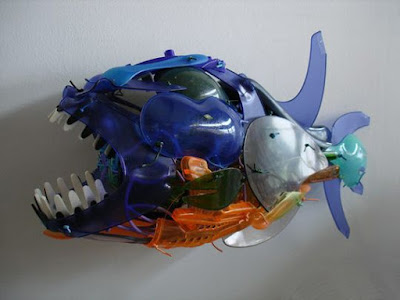
Sayaka Kajita Gans is a Japanese artist who recycles discarded kitchen utensils, toys and metal items by transforming them into emotive sculptures.


Sayaka Kajita Gans, Recycling Artist

Gans says that her work process reminds her of growing up in several different countries. Moving from one home to another throughout her childhood gave Gans a sense of disconnectedness, which is conveyed through her art. Each item that Gans chooses to use in her artworks are carefully selected, and must meet the requirement of being previously owned, used and discarded. Gans gives these pieces a new life by combining them to create an animal form that seems almost alive.


Gans uses flowing lines to create a sense of life and movement in her sculptures. Each creature seems to be frozen in time, like a single frame out of an animation. Each part of the animal is made up of a series of curves and arcs that further add to the sense of movement that the sculpture conveys. Art made with reclaimed objects is gaining popularity around the world, but it is a rarity to see such skill applied to recycled art.


When sketching, an artist will often create motion lines behind the subject to convey speed and movement. Gans has incorporated this technique into her sculptures, as seen above in the sculpture of a running cheetah, Fogo. These motion lines add to the sensation of movement in Gans’s work.


In Emergence, Gans has created two horses that appear to be emerging from a wall. The incompleteness of the horse’s bodies portray Gans’s sense of disconnectedness. It creates a transitory feeling of life existing only in a moment, fading into the past within seconds, never to be reclaimed. In converse, it can also form the idea that life emerges from the past, yet is always tied to its beginnings.
 In Emergence, one can easily see the shapes of some of the found objects that Gans has used. The ears on the black horse are spades, and the ears on the white horse are large spoons.


This piece uses several individual sculptures to create the finished product, Plunge. The penguins depicted appear to be plunging into water, even though they are hung in air. The piece gives the viewer the fun sensation that they are standing beneath the surface of the water watching the penguins dive. Gans has given the impression of water movement behind the penguins by twisting wire into swirls. 

Below are more examples of Gans’s sculptures. You can visit her website at SayakaGans.com

Specimens of Mythological Creatures Displayed in Japanese Museum

The Museum of Fantastic Specimens exhibits specimens of fantasy and mythological creatures. This cryptozoology museum is curated by Hajime Emoto, based in Japan.

Cryptzoology Explained
Cryptozoology can be translated from Greek to mean “the study of hidden animals”. Cryptozoology is a pseudoscience, as the animals that cryptozoologists focus on have no physical evidence according to mainstream biology. These are animals, creatures and humanoids that appear in myths, legends and fairytales.
Animals that are studied by cryptozoologists are often referred to as cryptids. Examples of cryptids are the Loch Ness Monster, Big Foot and the Chupacabra. The term can also be used for fairies, ogres, goblins and elves. The search for living specimens of creatures that are believed to be extinct, such as dinosaurs, the quagga or the dodo bird, can also be classified as cryptozoology. Many scientists criticize the ’science’ of cryptozoology, as cryptozoologists rely on anecdotal information such as myths, legends and folklore, instead of physical evidence or fact.


Creatures from Mythology and Fantasy
Fairy tales have existed for centuries as part of mythology, folk lore and children's stories. Most of the creatures in these tales have some inhumane ability such as flying or performing magic. Other creatures like elves and fairies have human characteristics but an inhuman form.
Human beings have always been fascinated with tales of fantasy and otherworldly happenings. Aliens and monsters have especially found their way into people's lives as a way to explain unusual or bizarre occurrences. What adds to the mystery of these creatures is that there is no physical evidence to prove they exist. But then again, there's no physical evidence to prove that they don't.


Above: Homo Pumilis Gidoronia: Microid Female. This is a specimen of a female fairy. Fairies are said to be insect-sized human beings with butterfly or dragonfly wings. [source]


Above: Homo Pumilis Gidoronia: Mocroid Male. Specimen of a male fairy. Unlike the female fairy, the male fairy's wings are practical in design, serving the purpose of flying. Attracting a mate is the job of the female fairy, hence the beautiful butterfly wings. [source]


Above: Draconis Arbuscula (Bush Dragon). A lesser known specie of dragon; the Bush Dragon is nevertheless popular in fairy societies, where they are kept as riding animals. Pure bred Bush Dragons are often sold for enormous amounts of money. Therefore, the more dragons a fairy owns, the wealthier they are deemed to be. [source]


Above: Draconis Transylvania (Romanian Dragon). A fighting dragon, used by fairy warriors in the gladiator arena. The Romanian Dragon is larger than the Bush Dragon, but can also carry a fairy rider. Romanian Dragons can breathe fire, suck blood and stab opponents with its wingtips. [source]


Above: Evil Beast #11. This creature is a common under-the-bed lurker. This one was bludgeoned to death by a 12-year-old in Essex, England. Ironically, the kid used a hardcover copy of a Harry Potter novel as his weapon. It is said the creature's last words were, "I'm not Dobby!" [source]


Above: Evil Beast #22. This tiny devil is said to have the power of invisibility and likes to hang around the bottom of tequila bottles, waiting for unsuspecting drinkers to release the beast. [source]


Above: Scallop Crab. A sea creature that is extinct due to over-consumption. Scallop Crabs were an ideal dinner gift. The diner could eat both the scallop and the crab and then keep the shell as a memento. [source]


Above: Ira Jose. This is the thing that brushes past your legs when you're swimming in a lake. [source]

The Museum of Fantastic Specimens
The Museum of Fantastic Specimens is open 24 hours a day and can be visited here. It is a 3-story virtual museum that showcases Emoto’s imaginary taxidermy artworks. Each specimen is a papier mache sculpture; made using bamboo, paper and modelling paste. In the past, artists have created fake photographs of 'sightings' of cryptids, but Emoto has taken the art of cryptozoology to a new level, by constructing 'specimens' of mythological creature remains. His designs are eerily realistic, with a degree of intricate detail not found in many papier mache sculptures. From claw to tooth, these models appear to be quite real, as if Emoto has simply found them lying beneath a pile of leaves or sand. Sadly, these macabre creature cadavers aren’t real…

Or are they?


Read More on Art-Sci:
 10 Freaky Photoshop Artworks

Lord of The Rings Inspires Real Hobbit Houses

JRR Tolkien wrote his epic fantasy novel, The Lord of the Rings, between 1937 and 1949. Since then it has inspired a huge amount of fan art, focusing on Tolkien’s detailed characters. Lord of the Ring fanatics have even recreated scenery from Tolkien’s Middle Earth, such as these Hobbit houses.


Hobbits

Tolkien describes hobbits as being humanoid in appearance, measuring between 2 and 4 feet. They have curly brown hair on their feet, which have leathery soles. Hobbits are not as stocky as dwarves, yet have a stout build. Their ears are slightly pointed.
Hobbits live in ‘hobbit-holes’, homes that are dug into the earth banks and feature round doors and windows. Hobbits are renowned for their hospitality and invented the custom of giving away presents on their birthdays. Their culture revolves largely around food, as hobbits eat several times a day and have enormous appetites. It is said that hobbits invented the art of smoking “pipe-weed”.

Artist’s depiction of a Hobbit House by Guy Sheperd


Real Hobbit Houses

Although Tolkien’s fantasy realm does not exist on our planet Earth, it has been a source of inspiration for fans of the fantasy genre. Some of these folk have followed the example of the hobbits and designed homes based on Hobbit Holes.

Peter Archer

Architect Peter Archer designed the hobbit house, below, on a larger scale so that it’s human inhabitants could comfortably live there. Archer incorporated the round doors and windows of hobbit houses into his design.


Simon Dale

Simon Dale built this hobbit house for his family in Wales. The house was built using natural materials found in the area, and has been dug into a hillside to create a Hobbit Hole effect.


Matamata, New Zealand

The original set for the Lord of the Rings trilogy still exists on farms around Matamata, New Zealand. This area has become known as Hobbiton, and attracts numerous visitors from around the world each year. Film director Peter Jackson chose this area as a setting for the movie trilogy because of its rich, pastoral farmlands.