Showing posts with label animals. Show all posts

Meet Batman's Furry Sidekicks: the Bat Dogs!

Batman is a DC Comics character that was created in the late 1930s by artist Bob Kane and writer Bill Finger. Batman is also referred to as 'The Caped Crusader' and 'The Dark Knight'. Although Batman has many human companions, he doesn't have any pets. If Batman ever did decide to keep pets, what would his dogs look like?


Bat Dogs in The 'Bark' Night


Combining their excellent sense of smell, loyalty and dog breath with the flying and hearing powers of bats, bat dogs make excellent slobbering sidekicks. Using their bark as sonar, bat dogs can follow their nemesis (usually Cat Woman) through busy streets, either on the ground or from the air. Dogs make excellent superhero sidekicks, as they are very loyal and are generally of a good height to bite baddies in the bottom.


Bat Dogs Defeat Kitty Criminals

Batdogs have one nemesis, the cat. before becoming bat dogs, many ordinary dogs were often outsmarted by these hissing creatures that could climb out of reach. But now, endowed with the powers of bat flight, batdogs can follow their feline enemies no matter how high they climb.


Batdogs make a Halloween Appearance

Not all Batdogs wear their uniforms year-round. Some only don their costumes at Halloween, using the festivities and dress up traditions of Halloween to disguise their true natures as Bat Dogs. This way, they can hide in plain sight and still show allegiance to Batman and Robin.


Read More on Art-Sci:

10 Funny Photoshop Dogs
Antique Lolcat Photographs make Kitteh Historeh
Calvin and Hobbes Fan Art: Tattoos
Funny Pictures of Dogs Shaking off Water

Recycled Kitchen Utensils become Art

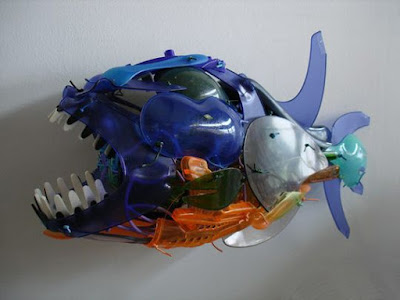
Sayaka Kajita Gans is a Japanese artist who recycles discarded kitchen utensils, toys and metal items by transforming them into emotive sculptures.


Sayaka Kajita Gans, Recycling Artist

Gans says that her work process reminds her of growing up in several different countries. Moving from one home to another throughout her childhood gave Gans a sense of disconnectedness, which is conveyed through her art. Each item that Gans chooses to use in her artworks are carefully selected, and must meet the requirement of being previously owned, used and discarded. Gans gives these pieces a new life by combining them to create an animal form that seems almost alive.


Gans uses flowing lines to create a sense of life and movement in her sculptures. Each creature seems to be frozen in time, like a single frame out of an animation. Each part of the animal is made up of a series of curves and arcs that further add to the sense of movement that the sculpture conveys. Art made with reclaimed objects is gaining popularity around the world, but it is a rarity to see such skill applied to recycled art.


When sketching, an artist will often create motion lines behind the subject to convey speed and movement. Gans has incorporated this technique into her sculptures, as seen above in the sculpture of a running cheetah, Fogo. These motion lines add to the sensation of movement in Gans’s work.


In Emergence, Gans has created two horses that appear to be emerging from a wall. The incompleteness of the horse’s bodies portray Gans’s sense of disconnectedness. It creates a transitory feeling of life existing only in a moment, fading into the past within seconds, never to be reclaimed. In converse, it can also form the idea that life emerges from the past, yet is always tied to its beginnings.
 In Emergence, one can easily see the shapes of some of the found objects that Gans has used. The ears on the black horse are spades, and the ears on the white horse are large spoons.


This piece uses several individual sculptures to create the finished product, Plunge. The penguins depicted appear to be plunging into water, even though they are hung in air. The piece gives the viewer the fun sensation that they are standing beneath the surface of the water watching the penguins dive. Gans has given the impression of water movement behind the penguins by twisting wire into swirls. 

Below are more examples of Gans’s sculptures. You can visit her website at SayakaGans.com