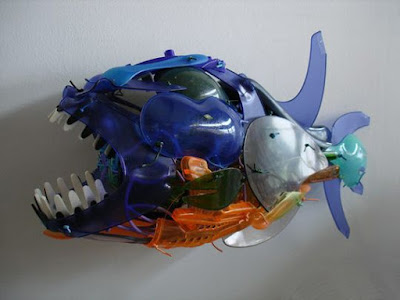
Sayaka Kajita Gans is a Japanese artist who recycles discarded kitchen utensils, toys and metal items by transforming them into emotive sculptures.
Sayaka Kajita Gans, Recycling Artist
Gans says that her work process reminds her of growing up in several different countries. Moving from one home to another throughout her childhood gave Gans a sense of disconnectedness, which is conveyed through her art. Each item that Gans chooses to use in her artworks are carefully selected, and must meet the requirement of being previously owned, used and discarded. Gans gives these pieces a new life by combining them to create an animal form that seems almost alive.
Gans uses flowing lines to create a sense of life and movement in her sculptures. Each creature seems to be frozen in time, like a single frame out of an animation. Each part of the animal is made up of a series of curves and arcs that further add to the sense of movement that the sculpture conveys. Art made with reclaimed objects is gaining popularity around the world, but it is a rarity to see such skill applied to recycled art.
When sketching, an artist will often create motion lines behind the subject to convey speed and movement. Gans has incorporated this technique into her sculptures, as seen above in the sculpture of a running cheetah, Fogo. These motion lines add to the sensation of movement in Gans’s work.
In Emergence, Gans has created two horses that appear to be emerging from a wall. The incompleteness of the horse’s bodies portray Gans’s sense of disconnectedness. It creates a transitory feeling of life existing only in a moment, fading into the past within seconds, never to be reclaimed. In converse, it can also form the idea that life emerges from the past, yet is always tied to its beginnings.
In Emergence, one can easily see the shapes of some of the found objects that Gans has used. The ears on the black horse are spades, and the ears on the white horse are large spoons.
This piece uses several individual sculptures to create the finished product, Plunge. The penguins depicted appear to be plunging into water, even though they are hung in air. The piece gives the viewer the fun sensation that they are standing beneath the surface of the water watching the penguins dive. Gans has given the impression of water movement behind the penguins by twisting wire into swirls.
Below are more examples of Gans’s sculptures. You can visit her website at SayakaGans.com
The Museum of Fantastic Specimens exhibits specimens of fantasy and mythological creatures. This cryptozoology museum is curated by Hajime Emoto, based in Japan.
Cryptzoology Explained
Cryptozoology can be translated from Greek to mean “the study of hidden animals”. Cryptozoology is a pseudoscience, as the animals that cryptozoologists focus on have no physical evidence according to mainstream biology. These are animals, creatures and humanoids that appear in myths, legends and fairytales.
Animals that are studied by cryptozoologists are often referred to as cryptids. Examples of cryptids are the Loch Ness Monster, Big Foot and the Chupacabra. The term can also be used for fairies, ogres, goblins and elves. The search for living specimens of creatures that are believed to be extinct, such as dinosaurs, the quagga or the dodo bird, can also be classified as cryptozoology. Many scientists criticize the ’science’ of cryptozoology, as cryptozoologists rely on anecdotal information such as myths, legends and folklore, instead of physical evidence or fact.
Creatures from Mythology and Fantasy
Fairy tales have existed for centuries as part of mythology, folk lore and children's stories. Most of the creatures in these tales have some inhumane ability such as flying or performing magic. Other creatures like elves and fairies have human characteristics but an inhuman form.
Human beings have always been fascinated with tales of fantasy and otherworldly happenings. Aliens and monsters have especially found their way into people's lives as a way to explain unusual or bizarre occurrences. What adds to the mystery of these creatures is that there is no physical evidence to prove they exist. But then again, there's no physical evidence to prove that they don't.
Above: Homo Pumilis Gidoronia: Microid Female. This is a specimen of a female fairy. Fairies are said to be insect-sized human beings with butterfly or dragonfly wings. [source]
Above: Homo Pumilis Gidoronia: Mocroid Male. Specimen of a male fairy. Unlike the female fairy, the male fairy's wings are practical in design, serving the purpose of flying. Attracting a mate is the job of the female fairy, hence the beautiful butterfly wings. [source]
Above: Draconis Arbuscula (Bush Dragon). A lesser known specie of dragon; the Bush Dragon is nevertheless popular in fairy societies, where they are kept as riding animals. Pure bred Bush Dragons are often sold for enormous amounts of money. Therefore, the more dragons a fairy owns, the wealthier they are deemed to be. [source]
Above: Draconis Transylvania (Romanian Dragon). A fighting dragon, used by fairy warriors in the gladiator arena. The Romanian Dragon is larger than the Bush Dragon, but can also carry a fairy rider. Romanian Dragons can breathe fire, suck blood and stab opponents with its wingtips. [source]
Above: Evil Beast #11. This creature is a common under-the-bed lurker. This one was bludgeoned to death by a 12-year-old in Essex, England. Ironically, the kid used a hardcover copy of a Harry Potter novel as his weapon. It is said the creature's last words were, "I'm not Dobby!" [source]
Above: Evil Beast #22. This tiny devil is said to have the power of invisibility and likes to hang around the bottom of tequila bottles, waiting for unsuspecting drinkers to release the beast. [source]
Above: Scallop Crab. A sea creature that is extinct due to over-consumption. Scallop Crabs were an ideal dinner gift. The diner could eat both the scallop and the crab and then keep the shell as a memento. [source]
Above: Ira Jose. This is the thing that brushes past your legs when you're swimming in a lake. [source]
The Museum of Fantastic Specimens
The Museum of Fantastic Specimens is open 24 hours a day and can be visited here. It is a 3-story virtual museum that showcases Emoto’s imaginary taxidermy artworks. Each specimen is a papier mache sculpture; made using bamboo, paper and modelling paste. In the past, artists have created fake photographs of 'sightings' of cryptids, but Emoto has taken the art of cryptozoology to a new level, by constructing 'specimens' of mythological creature remains. His designs are eerily realistic, with a degree of intricate detail not found in many papier mache sculptures. From claw to tooth, these models appear to be quite real, as if Emoto has simply found them lying beneath a pile of leaves or sand. Sadly, these macabre creature cadavers aren’t real…
Or are they?
Read More on Art-Sci:
10 Freaky Photoshop Artworks